
Think Big
November 18, 2026
2 Students, 2 Family Factories, 1 Path to Charlotte
# Academia
# AcademiaProgram
# Students
# DscoopGrant
# Edge Conference
# HP
# Dscoop
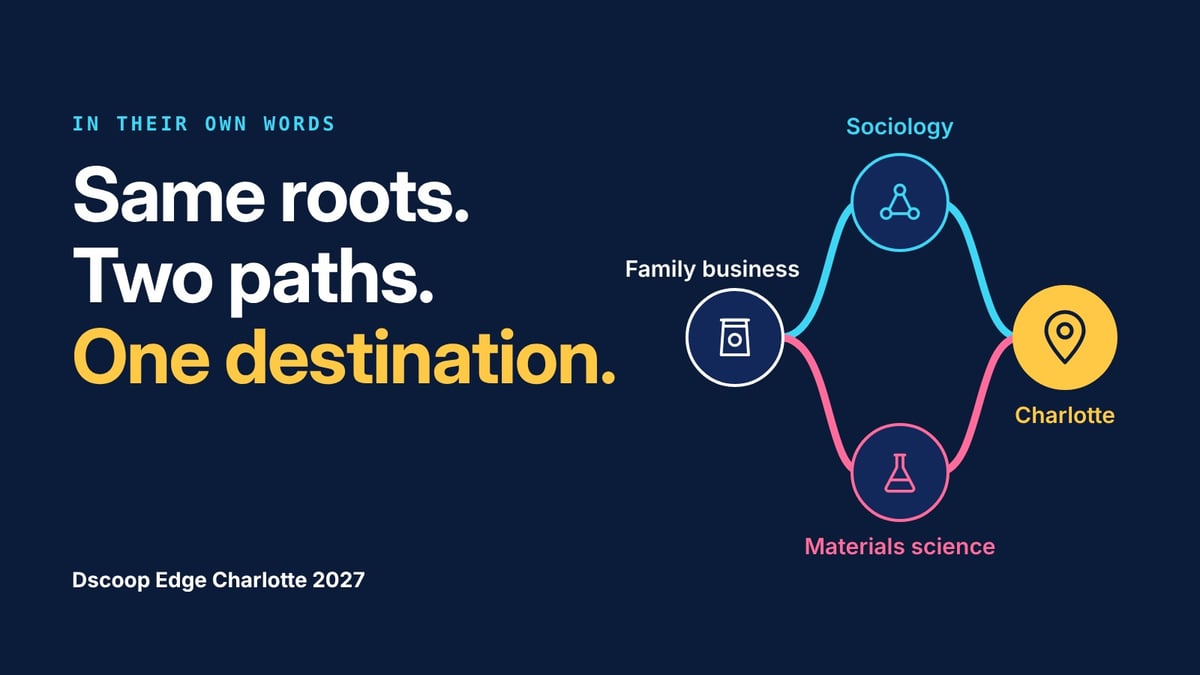
Yilin Gong of Beijing Normal University and Haoran Li of University College London grew up around their families’ flexible packaging businesses in China. Now headed to Edge Charlotte on student grants, they share what drew them to the industry and what they hope to learn from Dscoopers.
Two family packaging businesses in China, both running HP Indigo presses. Two students who grew up around the production floor. And two fields of study, sociology and materials science, that bring fresh perspectives to the industry their parents built.
Yilin Gong and Haoran Li are two of three Chinese students among the 37 heading to Dscoop Edge Charlotte 2027, Feb. 28–March 3, on grants through the Dscoop + FGCE Grant Program . The third studies at the University of Southern California. Yilin is pursuing a master’s degree in sociology at Beijing Normal University. Haoran is pursuing a master’s degree in advanced materials science at University College London. Neither studies printing, but both have worked their families’ stands at industry exhibitions, both interned with HP in 2026, and both are coming to Charlotte with questions for the Dscoopers who make these decisions every day.
Here are their stories, in their own words:
By Yilin Gong, Beijing Normal University
My childhood began with the rhythmic hum of machines in a small packaging factory in Shenzhen, China. My parents started their flexible packaging business as a modest family workshop, and for me, the factory was more than a place of production. It was a second home. I grew up playing with the workers’ children, making toys out of leftover packaging materials and sharing meals with the people who worked alongside my parents. Long before I understood how packaging was printed or produced, I was already part of the community behind it.
As I grew older, that childhood familiarity became active involvement. In 2023, I joined my family at a packaging industry exhibition in Thailand, where I welcomed visitors, introduced our products, translated for international customers and collected information from potential clients. It was my first direct experience of the excitement and challenges of international sales.
One observation stayed with me: Many visitors were interested in our ability to offer customized packaging with a minimum order of just 200 units. Their responses showed me how flexible production and customization can create opportunities for businesses serving different markets. As a sociology student, I have always been curious about people, their needs and the relationships they build. At the exhibition, I saw those interests turn into meaningful business conversations. A product made in Shenzhen could connect people and businesses across borders.
My family’s company, Jianhongxing, has undergone its own transformation. It began as a traditional flexible packaging manufacturer and expanded into digital printing with an HP Indigo 20000 press in 2018, later adopting HP Indigo 200K technology. I haven’t been directly involved in the technical side of production, but watching the company grow has made me more and more interested in the business opportunities digital printing creates. The demand for small-batch customization I saw in Thailand gave that technology a concrete commercial meaning. I began to think more seriously about how printing technology, customer demand and business strategy shape one another.
Today I am pursuing a master’s degree in sociology at Beijing Normal University. My studies have strengthened my research and analytical skills and deepened my interest in how technology, organizations and people relate to one another. That perspective helps me understand innovation itself and also how businesses identify customer needs, adapt their operations and respond to changing markets.
In summer 2026, I interned with the Go-to-Market team at HP Industrial Print, Greater China. I worked with colleagues across operations, business development, marketing and supplies to explore opportunities for AI-enabled automation, from industry research to helping build AI agents for product information retrieval. The internship showed me another side of the industry: how technology providers understand business challenges, coordinate across functions and find new ways to improve operations.
I am still exploring my long-term career path, but I hope to stay involved in printing and packaging. If I take on greater responsibility in my family’s business, I would like to help lead its next stage, building on its digital printing capabilities while exploring smarter operations, new business models and international markets. I am especially interested in how innovation can help manufacturers serve customers more flexibly and grow sustainably.
At Edge Charlotte, I want to learn how digital printing companies respond to demand for short runs and customized packaging, how they turn technology into competitive business models and how automation fits into existing operations. I also look forward to exchanging ideas with peers from around the world.
For me, printingand packaging have never been simply an industry I discovered through my studies. They are part of the world I grew up in and, increasingly, a field in which I hope to find my own place. From playing with packaging scraps as a child to introducing our products to international customers, my relationship with this industry has grown alongside me. I hope Edge Charlotte helps me take the next step in that journey.
By Haoran Li, University College London
During university holidays, I often spent time in the quality-testing laboratory at my family’s flexible packaging factory in China. I learned how raw materials and finished products are tested for coefficient of friction, residual solvent levels, tear resistance and impact resistance. Those tests changed how I saw something as ordinary as packaging. Behind every finished package were decisions about materials, production, quality and the needs of the people who would use it.
My connection to the industry began with my father, who runs the business, but my interest has gradually become my own. At Pet Fair Asia in Shanghai in 2024 and 2026, I helped prepare the company’s exhibition stand, introduced products, welcomed visitors and translated during conversations with customers. Seeing how businesses explain the value of their products and respond to customers made me curious about the connection between technical performance and commercial success.
My interest in chemistry started at school, encouraged by my chemistry teacher. I went on to earn a bachelor’s degree in chemistry at King’s College London, where I received the Ivor John Prize in Chemistry. Now I am studying for a master’s degree in advanced materials science, focused on materials innovation and enterprise, at University College London. I chose the program to deepen my understanding of materials and learn how scientific ideas become commercially viable innovations. Packaging gives me a practical field in which to pursue both.
My 2026 internship with HP Indigo introduced me to printing applications, different substrates and the possibilities of digital printing. I became interested in how shorter runs and personalization could help packaging businesses respond to changing customer needs.
I also helped plan the HP Indigo Changemakers event in Qingdao, which brought together young professionals from printing businesses. I proposed a networking activity called “Resource Message in a Bottle,” in which participants shared the resources they could offer and the support they were looking for. The idea was adopted for the event. It gave people a concrete starting point for conversation and helped them see where they might support one another. Having my proposal accepted encouraged me to keep contributing ideas, even while I am still learning about the industry.
Looking ahead, I hope to work in packaging innovation, applying my chemistry and materials knowledge to solutions that improve environmental performance while meeting manufacturing and customer needs. I am particularly interested in how more recyclable materials can keep the protective qualities packaging requires. My time in the factory taught me to weigh production costs and reliability, too. I want to understand how a promising material becomes a packaging product that a manufacturer can produce consistently and a customer will choose.
At Edge Charlotte, I hope to learn how printing and packaging businesses make these decisions in practice. I would like to ask manufacturers how they weigh recyclability alongside durability and cost, and what they test before introducing a new material into production. I also want to understand how different packaging materials work with digital printing, and when shorter, customized runs make commercial sense. The Operations and Business Strategy tracks will help me explore both production challenges and the decisions involved in adopting new technology.
I will bring my experience in a family packaging business, my scientific training and a willingness to share ideas. I hope to leave Charlotte with a clearer sense of where I can contribute and which technical skills I should develop next. I also want to share what I learn with the team at my family’s factory and explore how these ideas might be put into practice.
Meet Them in Charlotte!
Look for Yilin, Haoran and the rest of the Edge Charlotte student class in the Solutions Showcase, Feb. 28–March 3, 2027.