Education
November 9, 2026
Where Are You On the 6 Levels of AI Adoption?
# Artificial Intelligence
# Strategy
# Summit
# Vietnam Summit
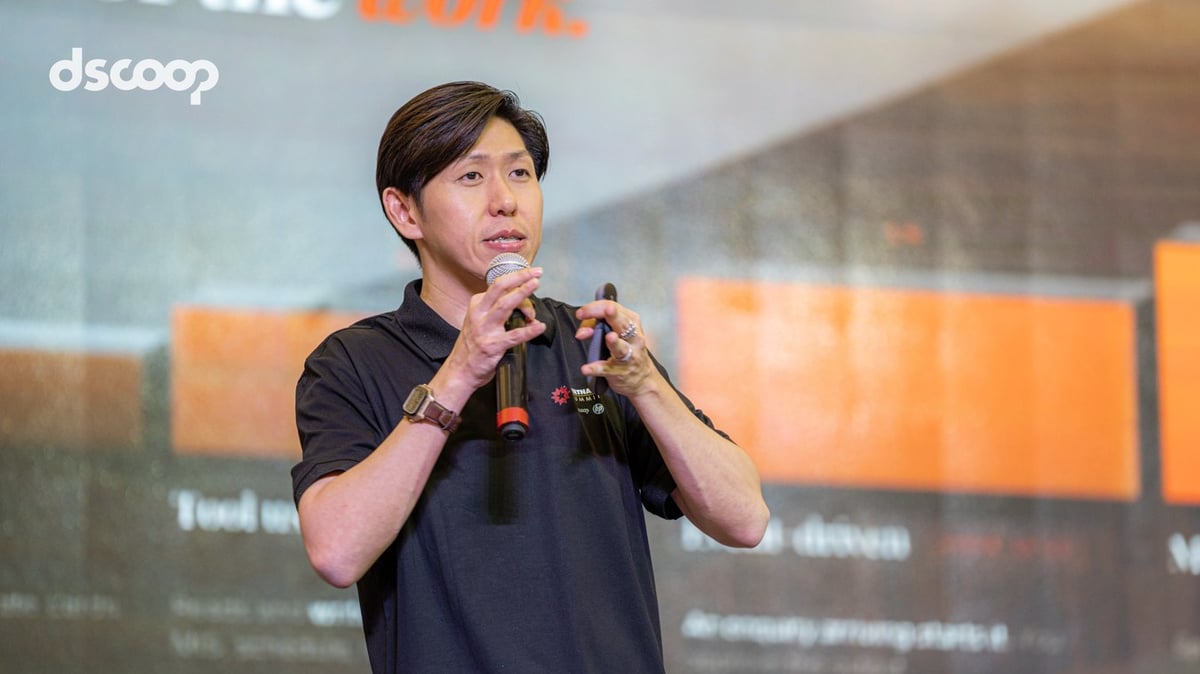
In the first of a two-part series on AI improvement, Freddy Lim’s “Too Fast to Predict” workshop gives PSPs a framework for understanding where they are on their AI journey — and what they should do next.
Artificial intelligence is developing faster than most organizations can plan for it. A task that appears unreliable, slow, or too expensive today may become commercially practical within a few months. This creates a challenge for PSPs: Should they invest in what AI can do now, or wait for the technology to mature?
Speaking at the Dscoop Vietnam Summit 2026, Freddy Lim of the Claude Singapore Community argued that businesses should do both. They should begin with dependable, valuable applications today while preparing their data, systems, and workflows for the capabilities coming next.
The objective is not to predict exactly what AI will be able to do in one or two years. According to Lim, the market is moving too quickly for that. Instead, business leaders should understand their current level of AI adoption and identify the next practical step.
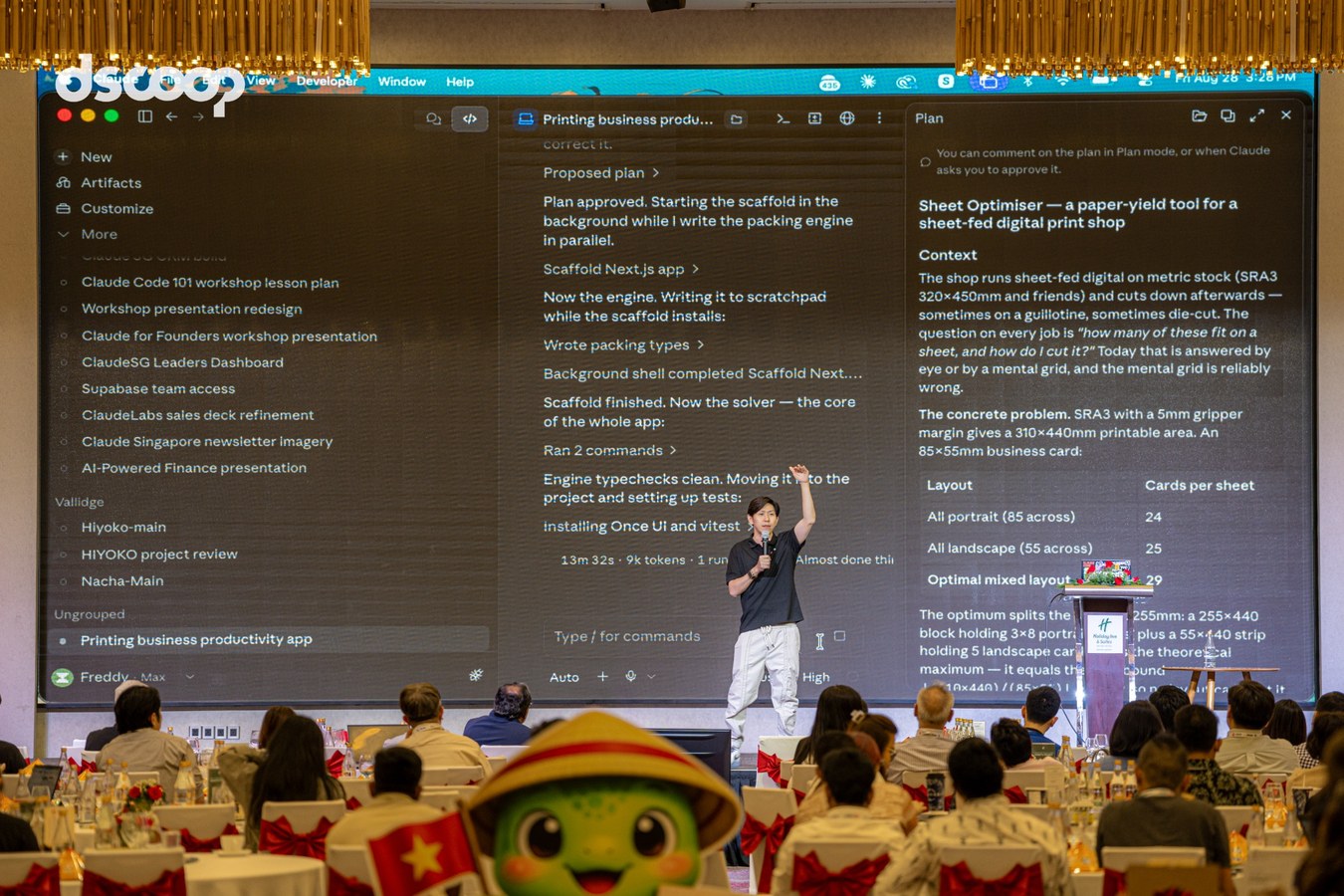
AI is improving faster than normal business cycles
Many businesses evaluate AI by testing a tool once and deciding whether it can complete a task perfectly. Freddy suggested that this approach overlooks the speed of improvement. An application that is not sufficiently accurate today may perform much better after the next generation of models is released.
For a PSP, this could include tasks such as ...
- Inspecting supplied artwork
- Extracting specifications from customer emails
- Estimating production requirements
- Calculating efficient sheet usage
- Identifying scheduling conflicts
- Producing quotations
- Analyzing operational data
Some of these applications may already work well. Others may still require significant human review. The important point is to distinguish between a fundamentally unsuitable idea and one that is likely to become viable as models improve.
This allows a business to begin preparing the workflow, data and operating rules before the technology reaches full maturity.
What is an AI agent?
Terms such as “AI agent,” “agentic AI” and “multi-agent orchestration” can make the subject sound more complicated than it needs to be.
Freddy offered a simpler explanation: An AI agent is essentially a workflow. One workflow might research a subject. A second could analyze the findings. A third might prepare a proposal, while another reviews the result. When several specialized workflows operate together, the system is often described as multi-agent orchestration.
However, the underlying business questions remain straightforward:
- What task must be completed?
- What information is required?
- What decisions need to be made?
- What result should the workflow produce?
- Where is human approval necessary?
Understanding the workflow is more valuable than mastering the latest terminology, Freddy said.
Reliable delegation and human oversight
The ability to automate a task does not necessarily mean it should operate without supervision. Freddy described the current stage of business AI as one of "reliable delegation." Companies are learning which tasks can safely be assigned to AI and where people still need to inspect, approve or correct the result.
This is often called “human in the loop," and the appropriate level of oversight depends on the consequences of an error, he said. For example, a low-risk internal summary may not need formal approval. A quotation sent to a major customer or a change to a production schedule may require an experienced employee to review it.
The goal is not to remove people from every process. It is to use their attention where judgment and accountability are most valuable.
AI must produce measurable business value
Freddy also challenged businesses to examine why they want to use AI. “Productivity” is frequently presented as the reason, but productivity by itself may be too vague to justify a substantial investment. If a company spends money developing an AI system and continues paying for software, infrastructure and maintenance, it should be able to identify the resulting value, he said.
For a PSP, useful outcomes could include:
- Shorter quotation turnaround times
- Higher conversion rates
- Fewer artwork-related errors
- Better press and finishing-equipment utilization
- Fewer scheduling conflicts
- Faster collection of overdue payments
Freddy compared AI investment with employing a member of staff. A salary is justified by the value the employee creates. An AI system should be evaluated in a similar way.
The 6 levels of AI adoption
Freddy presented six levels that businesses can use to assess their progress:
Level 1: Copy and paste
At the first level, an employee uses an AI tool as a separate assistant. They might ask it to draft an email, summarize a document, or rewrite marketing copy. The employee then copies the answer into an email, document, or other application.
This is a useful introduction to AI, but the process remains highly manual. The user must provide the information, initiate every step and transfer the result.
Moving beyond Level 1: Identify tasks that repeatedly require the same background information. Those tasks may benefit from connected files, reusable instructions, or dedicated project folders.
Level 2: Connected files and folders
At the second level, AI can access the documents required for a particular area of work. These might include product specs, price lists, substrate information, brand guidelines, or customer documents.
Connected information reduces repeated uploading and allows AI to answer questions using the organization’s knowledge. However, businesses must control access carefully. The system should only be able to use information that the employee and organization are authorized to provide.
Moving beyond Level 2: Organize frequently used documents into clearly defined folders. Remove obsolete or duplicate information, identify authoritative versions and establish appropriate permissions.
Level 3: Connected business tools
At the third level, AI is connected to applications such as Gmail, Outlook, Google Drive, Microsoft 365, Slack, CRM systems, accounting platforms, and project management tools.
An employee could ask AI to retrieve a customer’s latest email, find the relevant job information, compare it with a pricing policy and prepare a response. This reduces the need to move manually between systems. The user may still initiate each task, but the AI is beginning to operate inside the workflow rather than outside it.
Moving beyond Level 3: Select one frequently used business application and connect it to a specific, measurable use case. Avoid connecting every available platform without a clear purpose.
Level 4: Event-driven automation
At the fourth level, a defined event automatically begins the workflow. A trigger could be a quotation request arriving by email, a customer uploading artwork, an order being approved, a deposit being received, a machine now unavailable, or a deadline approaching. The system no longer waits for an employee to prompt it.
Freddy illustrated this using an event website connected to a registration platform. Creating an event automatically generates a corresponding item on the website. When the event finishes, that item is removed. A separate process can then produce an attendance report. The same principle could be applied to a printing workflow. An incoming customer request could automatically trigger information extraction, artwork checks and quotation preparation.
Moving beyond Level 4: Choose a process that begins with a clear and repeatable event. Document what employees normally do after that event and determine which steps can be automated safely.
Level 5: Coordinated AI workflows
At the fifth level, several specialized workflows operate together. Some PSPs are building coordinated sales and production workflows around pricing, scheduling, reporting, and more. AI monitors progress and evaluates whether the outputs meet the required standards. This is what is often meant by "agent orchestration."
Moving beyond Level 5: Separate the overall process into clearly defined responsibilities. Establish what information moves between each stage, how quality is assessed and what conditions require human intervention.
Level 6: End-to-end automation
At the sixth level, the complete process runs from its initial trigger to its final result.
Consider this quotation and order workflow:
- A customer submits specifications and artwork.
- AI extracts the job requirements.
- The system identifies missing information.
- Artwork is checked against technical standards.
- Pricing is calculated using approved rules.
- A quotation is prepared.
- A responsible employee approves it when necessary.
- The quotation and payment link are sent.
- The customer accepts and pays the deposit.
- The approved job enters the production schedule.
- Its progress is monitored.
- Exceptions are escalated to the appropriate person.
- The customer receives status updates.
- The job is completed and invoiced.
If the process begins automatically and continues through completion, it becomes a closed loop.
Where should you start?
Freddy said a company should first determine its current stage among the six. Different departments may be at different levels at the same company. Marketing may use connected tools while production still relies on manual spreadsheets. Customer service may use AI for drafting replies but have no automation.
After assessing the current position, select one valuable workflow and move it up one level, he suggested. A business working at Level 1 might connect AI to its approved documents. A company at Level 2 might integrate email or cloud storage. A Level 3 operation could automate a recurring trigger. A company already using event-driven workflows might coordinate several of them.
The practical objective is steady progression.
The companies that benefit most from AI will not necessarily be those using the newest model, Freddy said. They will be those that understand their work well enough to transform it into a connected, measurable, and continuously improving system.
Sign in or Join the community
Innovating Print, Together

Create an account
Innovating Print, Together