Showcase
August 10, 2026
Peczuh Printing: The Human Layer That Holds Integration Together

# Workflow
# E-commerce
# Technology
# Strategy
# Partners
# Sales and Marketing
22 B2B storefronts, two platforms that have to stay in sync, and the question sitting on Jesse’s desk right now.
Jay Harris and Jesse Brooks work at opposite ends of the country. Jay is in Salt Lake City, UT, at Peczuh Printing's main facility. Jesse works remotely from Maine, managing the web-to-print operation from the other side of the country. Every new storefront depends on constant coordination between Jesse's work in Infigo and Jay's work inside the MIS before anything can move into production. The integration they run requires both of them to move at the same time.
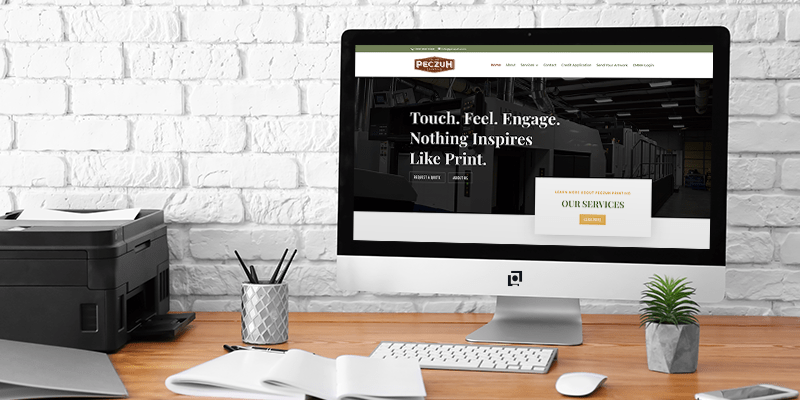
Peczuh is a B2B commercial printer with 22 active Infigo storefronts, all serving established business clients. There are no open consumer-facing sites. The operation does not compete for individual customers placing one-time orders. It runs managed portals for companies that order regularly, reliably, and at volume. That model demands a different kind of relationship with the platform. Rather than serving one-time buyers, the storefronts are designed for customers who place recurring orders week after week, making consistency, automation, and long-term account management more important than attracting new visitors.
Why They Switched to Infigo
Jesse notes that Peczuh's previous platform handled many tasks well, but struggled to support the company's multi-location operation and couldn't match the depth of integration available with its MIS. Infigo was recommended as the platform with the deepest integration capability for that system, while other capabilities, including pricing logic and product management, also proved stronger after the transition.
The migration took nearly two years. One large client required an extended period of parallel operation across both platforms before they were comfortable with the transition. Peczuh had to run two systems simultaneously, managing the complexity of both, until that last site crossed over. It was not the plan. It was the reality of serving a major account with a low tolerance for disruption.
First Touch at Press
Today, the automation behind the storefronts achieves something concrete: the first human touch in the production process happens at the press. An order placed through an Infigo storefront flows through the MIS, through prepress, and arrives at the production floor as an imposed, print-ready PDF.
No one touches the job before that moment. The operator simply loads the correct paper and prints. Behind the scenes, automation creates the sales order, routes the files through prepress, performs preflight, imposes the job, and delivers print-ready PDFs to the production floor before anyone ever touches the order.
The Children’s Miracle Network (CMN) portal illustrates the scale of what that automation manages. CMN serves 141 hospitals across the country. Every user is associated with their hospital. When they open a product, their hospital’s identity and artwork populate the template. The portal is constantly updated as hospital logos and contact information change. It is a highly dynamic system that produces consistent, correctly personalized output at scale. It's also one of their busiest portals, with users, logos and artwork changing continually throughout the year.
Other storefronts look completely different. One recently built for funeral homes lets customers upload photographs, choose from approved wording, personalize layouts and generate custom programs without starting from scratch.
An order placed through an Infigo storefront flows through the MIS, through prepress, and arrives at the production floor as an imposed, print-ready PDF.
The Build Process Requires Team Cohesion
Building that kind of system requires Jay and Jesse to work in sync across two platforms simultaneously. Jesse builds the product configurations in Infigo. Jay builds the corresponding product types in the MIS. Both sides have to communicate correctly before anything moves into production. For example, if the JSON configuration in Infigo does not match the product type structure in the MIS, orders do not flow. Finding that misalignment after a build takes time.
Jay and Jesse know they are often the critical path for new storefronts and product expansions because every new build depends on both systems working together correctly. As the storefronts become more sophisticated, both say the bottlenecks tend to be temporary. Solving one challenge usually reveals the next opportunity for automation until the workflow stabilizes again.
"Jay and I will develop a relationship with whoever the main point of contact is the customer," Jesse said.
In many cases, they become the customer's primary technical advisors, helping translate business goals into workflows that can actually be built and automated. Keeping those conversations direct reduces confusion and speeds decision-making.
Jesse was candid about the expertise gap. He describes himself as less fluent in Infigo than he was in the previous system. He is working through Infigo Academy to close that gap, not to bring all the work back in-house, but to ask better questions. He credits that outside expertise with accelerating the team's progress.
Rather than viewing Peczuh's implementation partner as a replacement, he describes them as an extension of the internal team, allowing him to focus on understanding the Infigo platform more deeply while relying on specialists for especially complex development work. His goal is to become knowledgeable enough to ask better questions and design better solutions.
Every product has to be scoped, built, configured, tested, and validated through direct conversation with the client. The work does not disappear because the interface looks simple.
The Magic Box Problem
Managing customer and sales rep expectations is the challenge that comes up in nearly every conversation about web-to-print, and Jay and Jesse name it directly. Customers believe the platform is a magic box. They assume that duplicating a storefront or adding a new product type is a quick task. But every product has to be scoped, built, configured, tested, and validated through direct conversation with the client. The work does not disappear because the interface looks simple.
"That's a real challenge when it comes to helping set customer and sales rep expectations where they believe not only is it their box, it's a magic box," Jesse said. "And you just imagine whatever you want and it's going to spit out 1,000 websites."
Every new storefront begins with a conversation about business needs before anyone writes code, because understanding the desired outcome comes long before deciding how to build it.
"A forum board would be the perfect situation to where I could post a thread and say, 'Hey, I am struggling to manage shipping when it comes to various sizes of products, which is one thing I'm going through right now with right now. Have any of you overcome this in any way, or met this issue?'" Jesse said. "And then someone could respond today, tomorrow or a week from now, but it's just kind of an open conversation going that would be ideal."
The issue on Jesse's desk today involves shipping logic for orders containing different product sizes. Rather than waiting for the next conference, he'd love a place to post the question, compare approaches with peers facing similar challenges, and learn from someone who's already solved it.
That desire for ongoing collaboration is exactly the kind of peer-to-peer problem-solving Dscoop hopes to encourage.
Note: Check Dscoop.com's Events area for an upcoming virtual roundtable that continues the discussion presented in this series.
Sign in or Join the community
Innovating Print, Together

Create an account
Innovating Print, Together
Dive in
Related
External Content
The Future of Book Manufacturing Is Not About Printing More. It Is About Printing Smarter
Aug 22nd, 2026 • Views 12
External Content
The Future of Book Manufacturing Is Not About Printing More. It Is About Printing Smarter
Aug 22nd, 2026 • Views 12