
Education
July 2, 2026
AI Will Take Your Managers. Speed Will Take the Rest. Here's How to Stay Ahead — Peter Hinssen keynote at Edge Slovenia
# #AI
# #DscoopIndia
# #EdgeSlovenia #PeterHinssen #Leadership #
My notes from the Peter Hinssen Keynote at Dscoop Edge Slovenia, June 2026.

Rashmi Sharma
AI Will Take Your Managers. Speed Will Take the Rest. Here's How to Stay Ahead — Peter Hinssen at Edge Slovenia
Keynote session | Edge Slovenia | June 2026
Peter Hinssen opened with a provocation that landed hard in the room: Managers will lose to AI. Salespeople will stay. Production will stay. Let that sink in for a moment. It's not the roles we typically worry about — the repetitive, the routine — that are most at risk. It's the middle layer of management, the people who aggregate information, synthesize reports, and make decisions based on data they didn't generate themselves. That's exactly what AI does better, faster, and cheaper. The humans who survive are the ones at the edges: those building relationships and those making things.
Innovation Is More Than a New Product Hinssen pushed back on the narrow way most companies think about innovation. We default to product innovation — a new feature, a better version, an upgraded SKU. But real innovation has four dimensions:
Product → Service → Model → Market
You can innovate in how you deliver (service), in how you charge and create value (model), or in who you serve and where you compete (market). The companies that only innovate at the product level are playing the smallest game available to them.
The Holy Trinity of Future-Proof Organizations The centerpiece of his talk was a framework he called the Holy Trinity — three capabilities every organisation needs to not just survive but thrive in a world of constant disruption:
1. Resilience The capacity to survive and recover from sudden shocks. This isn't about being rigid — it's about having enough structural strength that when the unexpected hits, you don't collapse. Resilience is your organizational immune system.
2. Anticipate The ability to predict change ahead of time. Not clairvoyance — pattern recognition. Organizations that read signals early, invest in foresight, and don't wait for disruption to arrive at their doorstep before they respond.
3. Adaptability The ability to course correct fast enough. This is the one most companies underestimate. It's not enough to see change coming — you need the organisational agility to actually pivot before the window closes. Three legs of the same stool. Remove any one and the whole thing tips over.
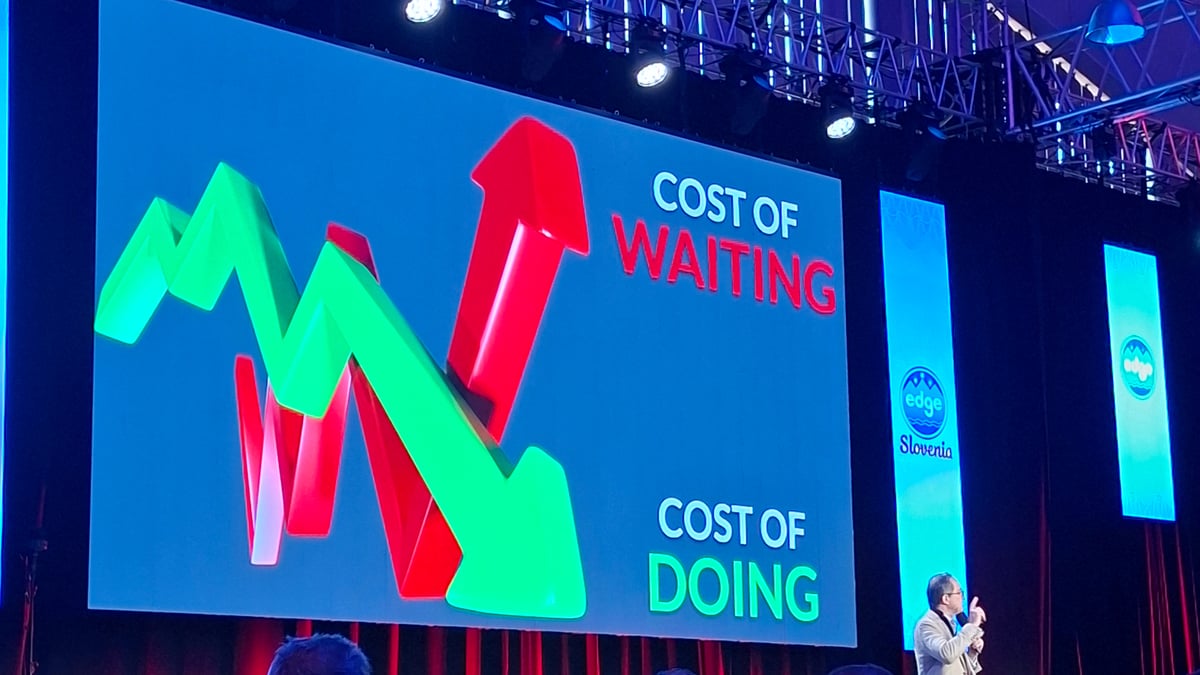
Speed Is Now the Only Real Competitive Advantage Hinssen made one of the sharpest observations I've heard in a while: Speed is more detrimental today than anything else. And the equation he put behind it:
Cost of time >>> Cost of production
Waiting >>> Doing
We have systematically overestimated the cost of moving fast and underestimated the cost of standing still. The price of a wrong product shipped quickly is recoverable. The price of the right product shipped too late is not. In the AI era, the half-life of competitive advantage is measured in months, not years. Organizations built around approval cycles, committee reviews, and consensus-by-exhaustion are structurally incapable of competing.
The 70-20-10-0 Growth Framework One of the most practically useful things Hinssen shared was a framework for how to allocate your energy and investment across time horizons — he called it the Day After Tomorrow Concept The idea is simple but counterintuitive. Most organisations spend too much time managing yesterday. SOY flips that completely: yesterday gets zero. It's shit of yesterday (SOY) — done, gone, stop defending it. Instead, the model allocates resources across three buckets: 70% → Today. Execute on what's working now. Generate the revenue that funds everything else. This is your core.20% → Tomorrow. Build what's coming next. Pilot, experiment, develop the near-horizon opportunities.10% → Day After Tomorrow. Scout the edges. Place small bets on ideas that aren't yet obvious — the things that will define your relevance five to ten years from now. 0% → Yesterday. Nothing. This is the hardest discipline. It means actively killing the products, processes, and mindsets that had their moment but no longer serve growth. Hinssen has written extensively about this model — the challenge isn't understanding it, it's actually doing it. Most companies collapse the 10% for the Day After Tomorrow under short-term pressure, and quietly keep funding yesterday out of habit or politics. The result: they win today and lose the future.
What I'm Reading Next
Two resources Hinssen pointed to that I'm taking seriously:
Book: The Power of Creative Destruction — Philippe Aghion. A deep dive into how economies and organisations renew themselves through the very disruption that threatens them.
Article: Matthew Prince — "How I Choose Which Employees to Replace with AI Today" — a candid, real-world look at the decisions leaders are already making. Worth reading even if it's uncomfortable.
The Takeaway
What struck me about Hinssen's session wasn't any single idea — it was how everything connected.AI is reshaping who does what. That forces a rethink of where human value actually lives. Innovation can't just mean a new product — it has to reach into your service, model, and market. Speed is no longer a nice-to-have; the cost of waiting now outweighs the cost of being wrong. And none of it matters without the Holy Trinity: the resilience to absorb shocks, the foresight to anticipate change, and the adaptability to course correct before it's too late. Underpin all of that with the 70-20-10-0 discipline — stay grounded in today, invest in tomorrow, keep one eye on the day after, and have the courage to put zero into yesterday — and you have a genuine operating model for leading through disruption, not just surviving it. The leaders who leave Edge Slovenia and keep doing what they did before have already made their choice. The ones who act on even one of these ideas are a step ahead.😇
Notes from the Peter Hinssen keynote at Dscoop Edge Slovenia, June 2026.
Like
Comments (0)
Popular
